
If you’ve been researching custom home builders in Brisbane, you’ve probably seen ‘fixed price’ used as a selling point by almost everyone. And right now, with construction costs climbing and plenty of uncertainty in the air, it’s one of the first questions we hear from people considering a build:
‘Does a fixed price building contract actually mean my price won’t change?’
It’s an important question when you’re investing $800K+ into a home that’s supposed to be unmistakably yours. The honest answer is: it depends on what’s in the contract. ‘Fixed price’ can mean genuine protection, or it can mean very little, depending on how the document behind it is written and how much work the builder did before asking you to sign.
A fixed price building contract, sometimes called a lump sum contract, sets the total cost of building your home at the time of signing. Once that contract is executed, your builder absorbs any cost increases that arise during construction. Those increases don’t come back to you. In Queensland, residential builds typically use one of three standard fixed price contracts:
All three operate on this same principle, and under the QBCC Act 1991, the circumstances in which a builder can legitimately increase a contracted price are tightly defined.
That matters right now. Building costs across Brisbane have been rising. Industry forecaster Rider Levett Bucknall projects around 5% construction cost growth in Brisbane for 2026, among the higher rates in the country, partly due to the Olympic infrastructure pipeline drawing on the same labour and materials pool as residential builds. For anyone who has already signed a fixed price contract with a stable, well-resourced builder, those pressures stay firmly on the builder’s side of the ledger.
The key phrase here is ‘already signed’, which brings us to what can still move the price, even on a fixed price contract.
Even a well-written fixed price contract has defined circumstances where the price can shift. Understanding these before you sign anything is essential.
A provisional sum (PS) is an allowance for a scope of work where the exact cost can’t be confirmed at signing because it depends on site conditions that aren’t known yet. Common examples include excavation, site connections, drainage and stormwater management.
Under the QBCC Act, a builder is legally required to warrant that every provisional sum has been calculated with reasonable care and skill, using all the information available at the time. But it only protects you if the builder actually did the work to understand your site before drawing up the contract.
On sloping blocks, split-level sites and narrow lots, provisional sums deserve careful scrutiny. A site that hasn’t been properly investigated before contract will have larger, less certain PS items, and that uncertainty transfers risk back to you. A builder who completes thorough soil testing, engineering assessment and site analysis before quoting can keep PS items tight and well-founded.
The number of provisional sums in a contract, and the quality of the reasoning behind them, tells you far more about a builder’s integrity than the headline price.
Split-level design is commonly paired with stepped slab construction as it often works naturally with sloped ground, reduces excessive evacuation and adds architectural interest. The downside to a split-level design is that it introduces internal level changes, and not all households are suited to this (i.e., those requiring accessible properties with a flat floor plan). But a stepped slab can sit structurally beneath many split-level designs to allow the owner to follow the natural fall of the land without excessive ground reshaping.
Stepped slabs, in comparison, often help homeowners strike a balance. There are lower excavation costs compared to a full cut and fill, less reliance on retaining walls, and it delivers better adaptability to sloping block conditions.

Once you understand how provisional sums and variations work, the most useful thing you can do is ask your builder three straightforward questions before committing to anything:
A builder who answers these clearly and without hesitation is one you can trust. A builder who gets vague is telling you something worth hearing.
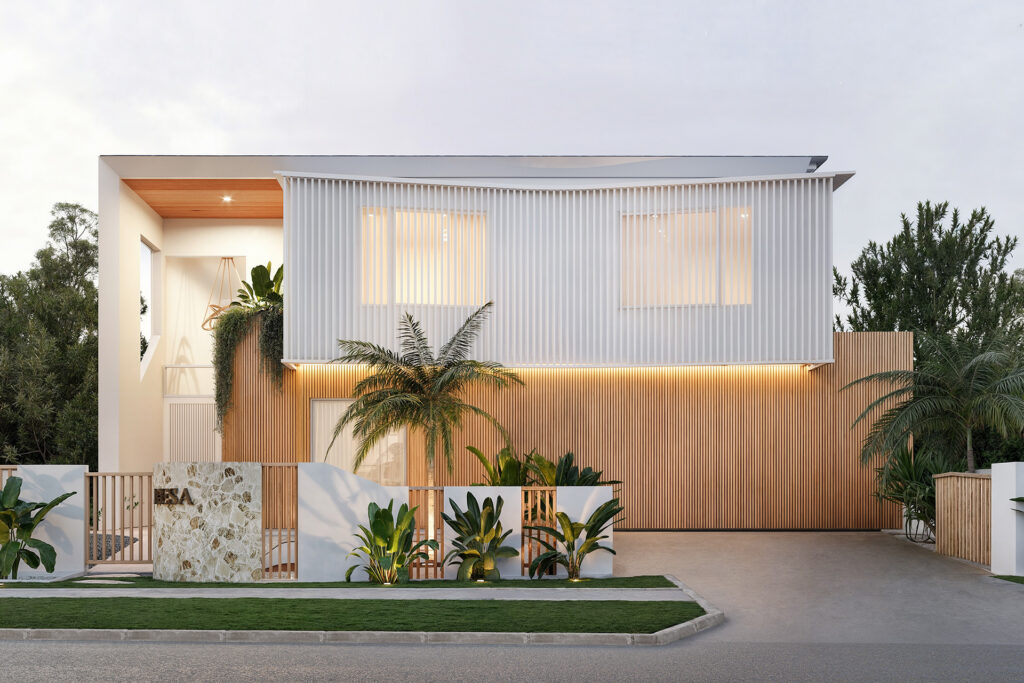
Our fixed price guarantee is built into the structure of how we work with every client. We take on between 20 and 25 custom homes per year, deliberately. That number gives our team the capacity to do the pre-contract work properly, and that work is what makes the guarantee mean something.
In Stage 1 of our process, we sit down with you, understand your vision, block and budget, and provide a free concept design and cost estimate. In Stage 2, we refine the design, complete our site assessment and prepare a detailed specification and tender plan before contract signing. The price you sign is based on completed design work, thorough site investigation and confirmed selections.
The reason we can do this consistently is the depth of experience behind us. Our estimating team combines construction knowledge with financial expertise, which means cost exposure gets identified before it becomes your problem. Our construction management team brings over two decades of on-site experience across a wide range of residential builds, catching what a less experienced team might miss on a complex site. And our directors, each with more than a decade across construction and property development, stay actively involved across every project.
On complex sites, this pre-contract rigour is especially important. These are the sites where a rushed quote creates the most exposure. They’re also the sites we’ve built our reputation on.
We’re a proud member of HIA and Master Builders Queensland, and hold QBCC Licence No. 15343489. Those memberships carry real compliance obligations and accountability standards.
*Already in conversation with us? If you have questions about how current conditions might affect your build, just ask. We’ll give you a straight answer.
A fixed price contract is one of the best protections available when you’re investing in a custom home. But it only holds as well as the builder behind it and the work they did before asking you to sign.
The right question isn’t just, ‘is this fixed price?’ It’s, ‘What did you do before issuing this quote to make sure the number doesn’t change?’
A builder who has properly investigated your site, worked through selections with you and built a specification that truly reflects how you want your home is a builder whose fixed price actually means something.
If you’d like to understand how our process works and what a BESA build would look like for your block and your vision, the first conversation costs nothing.
